


Distant Vision -- Francis Ford Coppola preparing another Italian American saga
 06-18-14 | 08:13 PM
#1
Thread Starter
DVD Talk Legend
Distant Vision -- Francis Ford Coppola preparing another Italian American saga
Dropping by the Produced By Conference earlier this month, the director revealed (via Variety) that he was writing "a multi-generational saga about an Italian American family not unlike his own." So, a return to the kind of storytelling that anchored "The Godfather"? It kinda sounds like it. Back in 2012, Coppola shared details of a project he was working on at the time, one that he said he was nearly ready to start shooting. "My story is set in New York. I have a first draft. I’m really ready for a casting phase," he said. "Movies are big in proportion to the period. It starts in the middle of the ‘20s, and there are sections in the ‘30s and the late ‘40s, and it goes until the late ‘60s."
 06-18-14 | 09:04 PM
#2
re: Distant Vision -- Francis Ford Coppola preparing another Italian American saga
thats such awesome news. Really LOVED the 3 films he made in the past 7-8 years. Its been about 4 years with no real news of a new project so I was starting to worry that since he was financing these films himself and none of them really made any money or found much of an audience, that he might have given up on that sort of thing. Hopefully this new project happens. Big Coppola fan.
 06-19-14 | 05:37 AM
#3

re: Distant Vision -- Francis Ford Coppola preparing another Italian American saga
Dropping by the Produced By Conference earlier this month, the director revealed (via Variety) that he was writing "a multi-generational saga about an Italian American family not unlike his own." So, a return to the kind of storytelling that anchored "The Godfather"? It kinda sounds like it. Back in 2012, Coppola shared details of a project he was working on at the time, one that he said he was nearly ready to start shooting. "My story is set in New York. I have a first draft. I’m really ready for a casting phase," he said. "Movies are big in proportion to the period. It starts in the middle of the ‘20s, and there are sections in the ‘30s and the late ‘40s, and it goes until the late ‘60s."
A true multi-generational Italian-American epic if ever there was one:

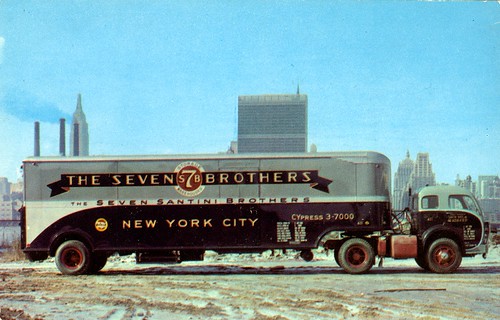

Too bad Hal Needham's no longer around to do the second unit direction of the trucking scenes.
Last edited by Ash Ketchum; 06-19-14 at 10:33 AM.
06-19-14 | 08:04 AM
#4

 08-26-24 | 09:08 AM
#5
Re: Distant Vision -- Francis Ford Coppola preparing another Italian American saga
Now that you’ve finally made Megalopolis, is that it for you?
No, I’m working on two potential projects right now. One is a regular sort of movie that I’d like someone to finance and make in England, because I don’t have a big history with my wife in England. Everywhere else I go, I’m reminded of her all the time. The other is called Distant Vision, which is the story of three generations of an Italian American family like mine, but fictionalized, during which the phenomenon of television was invented. I would finance it with whatever Megalopolis does. I’ll want to do another roll of the dice with that one.
No, I’m working on two potential projects right now. One is a regular sort of movie that I’d like someone to finance and make in England, because I don’t have a big history with my wife in England. Everywhere else I go, I’m reminded of her all the time. The other is called Distant Vision, which is the story of three generations of an Italian American family like mine, but fictionalized, during which the phenomenon of television was invented. I would finance it with whatever Megalopolis does. I’ll want to do another roll of the dice with that one.
For reference... from a few years back...
Francis Ford Coppola came one step closer to realizing his live cinema project called “Distant Vision,” with the completion of a two-month workshop shot at his alma mater, UCLA. Seventy Theater, Film and TV students served as active crew throughout all facets of production, operating more than 40 cameras. The “proof of concept” footage was broadcast and streamed live Friday night at UCLA.
“Distant Vision” (a 19th century term for television) explores three generations of an Italian-American family whose history spans the development of TV.
Coppola’s sprawling saga will take several years to complete, and since he’s experimenting with new narrative and tech, he’s decided to workshop portions of the script.
The concept of live cinema consists of utilizing feeds from various cameras, instant replay servers and other sources, all of which the director can switch live with the most technologically advanced broadcast equipment. Therefore, Coppola believes a new kind of movie-making is possible — performed live and viewed by an audience in real-time.
However, the process is more cinematic in nature than what we’re accustomed to with live broadcast drama or musicals, but has the in-the-moment energy of a live event.
Live cinema, according to Coppola, depends on a definitive script, extensive planning, rehearsal and coordination of a variety of sources, enabling the real-time selection of views, music and VFX to be combined into the desired expression of ideas and moods. Although the audience experiences the production in real-time, it has many choices of where and what type of viewing medium is used.
Thus, live cinema can be simultaneously performed throughout all distribution platforms (including streaming to home theaters or personal devices). It also offers the flexibility to make changes on the fly or to add live elements. It also gives actors and directors more creative control.
“I felt the need to experiment in order to learn the actual methodology of live cinema, which is a hybrid of theater, film and television. The shot is the basic element, as in film; the live performance is from theater; and the advanced television technology to enable it is borrowed from TV sports. It is very exciting to work in,” Coppola said in a prepared statement.
UCLA TFT (led by Dean Teri Schwartz) co-sponsored the workshop with Coppola’s American Zoetrope.
“Distant Vision” (a 19th century term for television) explores three generations of an Italian-American family whose history spans the development of TV.
Coppola’s sprawling saga will take several years to complete, and since he’s experimenting with new narrative and tech, he’s decided to workshop portions of the script.
The concept of live cinema consists of utilizing feeds from various cameras, instant replay servers and other sources, all of which the director can switch live with the most technologically advanced broadcast equipment. Therefore, Coppola believes a new kind of movie-making is possible — performed live and viewed by an audience in real-time.
However, the process is more cinematic in nature than what we’re accustomed to with live broadcast drama or musicals, but has the in-the-moment energy of a live event.
Live cinema, according to Coppola, depends on a definitive script, extensive planning, rehearsal and coordination of a variety of sources, enabling the real-time selection of views, music and VFX to be combined into the desired expression of ideas and moods. Although the audience experiences the production in real-time, it has many choices of where and what type of viewing medium is used.
Thus, live cinema can be simultaneously performed throughout all distribution platforms (including streaming to home theaters or personal devices). It also offers the flexibility to make changes on the fly or to add live elements. It also gives actors and directors more creative control.
“I felt the need to experiment in order to learn the actual methodology of live cinema, which is a hybrid of theater, film and television. The shot is the basic element, as in film; the live performance is from theater; and the advanced television technology to enable it is borrowed from TV sports. It is very exciting to work in,” Coppola said in a prepared statement.
UCLA TFT (led by Dean Teri Schwartz) co-sponsored the workshop with Coppola’s American Zoetrope.
