


"The Ghoul" (1933): A Classic Back From the Dead
 01-13-07 | 08:43 AM
#1
Thread Starter
Suspended
"The Ghoul" (1933): A Classic Back From the Dead
I'm starting this thread to share some of the love I have for this old film that has only recently resurfaced on DVD and had long been considered a "lost film".
First a bit of history (from this review by Ed Nguyen ):
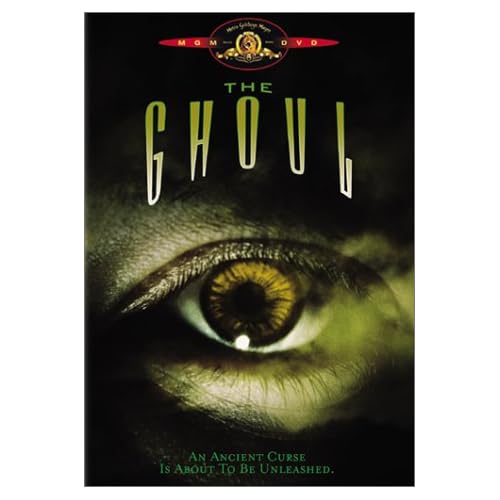
The MGM DVD (R1)
Opening Titles screen capture (click on the "Ghoul DVD" link)
About the MGM DVD
This is a DVD that came out in 2003, with no fanfare and no extras and is offered for practically no money. It shows the best transfer/film print of a film of that age I have ever seen, Metropolis notwithstanding. There are no stills or captures from the film that can do it justice. Not only is the underlying photography by Günther Krampf, shimmering on silvery nitrate film, a wonder of Rembrandt lighting and imaginative camera movement at its expressionist best, but the transfer has been meticulous and the digital restoration flawless. The picture is rock steady and appears almost high definition. This is the only black and white DVD I own, actually, that has so many gradings of grey and deep blacks that I feel no remorse in playing it in standard or "torch" mode: there is absolutely no loss of picture detail.
The sound is also miraculous. It has been optimized by Sonic Solutions so that both the dialogue and the music (a very elaborate score for the time by Hitchcock regulars Louis Levy and Leighton Lucas, with very atmospheric woodwinds and lower tonality instruments, one of whose themes was pilfered by Ernst Toch and Victor Young in their epochal 1940 score for The Ghost Breakers) are allowed to shine, sound natural, without any trace of hiss or loss of ambiance. Without resorting to "fake stereo", it comforably fills up any 5.1 set-up with great "fat mono" sound. Check out those MGM sample soundbites.
In my humble opinion, this is the best DVD value of an ancient film ever to surface outside of a Criterion edition, despite its lack of extras.

(Karloff and Kathleen Harrison)
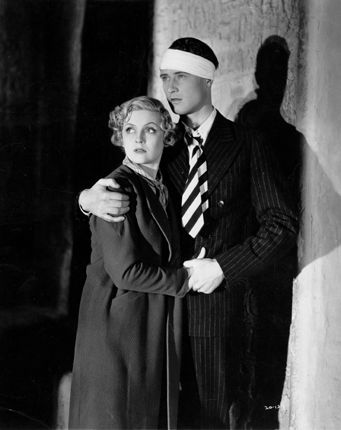
(Dorothy Hyson and Anthony Bushell)

(Dorothy Hyson and Karloff)
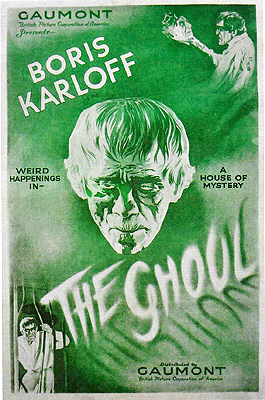
(Original poster)
About the film
This film was made, basically, because Karloff, tired of not sharing in the profits of his three hits for Universal (Frankenstein, The Mummy and The Old Dark House), went over to England to make himself more desirable. He was greeted by a British film industry eager to give Hollywood a run for its horror money. The director, T. Hayes Hunter, totally forgotten today, was one of the best of British silent cinema. The story, from a stage play by Frank King, is sort of a "Mummy meets The Old dark House" lark that reprises all the Mummy clichés that were floating around since Bram Stoker's "Jewel of the Seven Stars". The photography and art direction - by two German expressionists of renown, including The Archers' legendary art director Alfred Junge - are stupendous, especially the London fog scenes, the shimmering moonlit exteriors, the great detail of the interior scenes and the believability of the candlelit scenes. I was also pleasantly surprised by the mobility of the camera at all times and the realistic aspect of the action scenes. The atmosphere is suspenseful and chillingly mysterious and all the actors are extremely good (and famous!), including the two "young adorables" acting as principals, shapely Dorothy Hyson and stalwart Anthony Bushell (a Laurence Olivier collaborator). The acting is interesting down to the bit parts, including two British actors who give a definitive interpretation of Egyptian exotics (Harold Huth and D.A. Clarke-Smith).
The dialog is at least twice as witty as that found in the Universal horror flicks of the same era and the story actually makes sense, although, unfortunately, it is of the "Scooby-Doo" school of old dark house mysteries where everything is neatly tied up with a rational explanation at the end, leaving absolutely no room for belief in the supernatural. But this doesn't distract from the extreme intelligence of the whole, the great fun of watching all those clever actors turning in memorable performances and the extra bonus of watching a relative unknown one (Kathleen Harrison - Alastair Sim's maid in A Christmas Carol - in an amorous Carol Burnett-type of persona) stealing the show from everyone else at the end after going through every phase of infatuation, coyness, seduction, duplicity, raunchy double-entendre, sexual exploitation, rejection and revenge.
The film is a much more enjoyable watch than say, the original Dracula with its static staging. It has a little bit of everything for everybody, including a daring-for-its-time self-mutilation scene and comic relief that actually makes you laugh. But it should be prized at least for having been saved from total disappearance and as a precious time-travel piece that actually shows the viewer what a brand-new horror film looked like on its first day of projection back in 1933, where every single set-up is suitable for framing, almost three-dimensional and reminiscent of Stanley Kubrick's candle-lit accomplishments in Barry Lyndon. I enjoyed Ralph Richardson (as a country pastor) in every frame he's in and I am still in awe of Cedric Hardwicke's interpretation of an enigmatic solicitor which so closely resembles an impersonation of "Mr. Rat" from "The Wind in the Willows". Karloff is underemployed but effective as usual in balletic pantomime as Professor Morlant (which sounds like "slow death" - mort lente - in French) but Ernest Thesiger (who was in both James Whale's Old Dark House and Bride of Frankenstein) is priceless as a slow-witted butler with a club-foot and a Scottish brogue.
This film has very high entertainment and repeat value for the discriminating viewer and the DVD is being sold at a bargain-bin price. After surviving 70 years on the shelf, The Ghoul has become a must-have instant classic.

(Professor Morlant offering himself to Anubis)
First a bit of history (from this review by Ed Nguyen ):
The MGM DVD (R1)
Opening Titles screen capture (click on the "Ghoul DVD" link)
In 1932, legendary horror film icon Boris Karloff portrayed the mummified remains of Imhotep in the Universal classic The Mummy. The film was a smash hit for Universal and launched a series of successful films about the Egyptian movie monster. Shortly after completing The Mummy, Karloff returned to England, where he portrayed another undead creature in a film long considered lost - The Ghoul (1933).
The Ghoul had been one of the earliest British horror films of the sound era. In addition to a stellar cast including a young Ralph Richardson, The Ghoul had also featured the exceptional cinematography of Günther Krampf, best known for his exquisite work in German expressionism (most notably, Pandora's Box and Nosferatu). Unfortunately, the original film negative eventually succumbed to the ravages of time and The Ghoul itself became a "lost" film, gradually drifting out of public awareness.
For years, no prints were known to remain. The film existed solely in the memories of the lingering few who had once seen it. In time, a subtitled nitrate release print was eventually located in the Czech National Archives. However, in a cruel twist of fate, that print was not only incomplete [at 66 minutes] but was in such poor condition, with horribly grainy and degraded images, that the film itself was virtually unwatchable. Nevertheless, with no other available source, all subsequent copies of The Ghoul were struck from this sub-standard print. [They were actually shown "widescreen" with the bottom subtitled part cut off.]
The Ghoul would likely have remained in this nether-realm of obscurity were it not for the miraculous discovery of an uncut print at the British Film Institute. Not only was this print intact [at 81 minutes], but its picture quality was a significant improvement over the Czech print. Images which had previously been washed out or destroyed by nitrate deterioration in the Czech print were now crystal-clear. Film composition that had been cropped in prior prints could now be viewed for the first time in decades, further revealing the beauty of Krampf's cinematography. Thanks to meticulous restorative efforts by MGM, The Ghoul can be seen once more in all its glory.
The Ghoul had been one of the earliest British horror films of the sound era. In addition to a stellar cast including a young Ralph Richardson, The Ghoul had also featured the exceptional cinematography of Günther Krampf, best known for his exquisite work in German expressionism (most notably, Pandora's Box and Nosferatu). Unfortunately, the original film negative eventually succumbed to the ravages of time and The Ghoul itself became a "lost" film, gradually drifting out of public awareness.
For years, no prints were known to remain. The film existed solely in the memories of the lingering few who had once seen it. In time, a subtitled nitrate release print was eventually located in the Czech National Archives. However, in a cruel twist of fate, that print was not only incomplete [at 66 minutes] but was in such poor condition, with horribly grainy and degraded images, that the film itself was virtually unwatchable. Nevertheless, with no other available source, all subsequent copies of The Ghoul were struck from this sub-standard print. [They were actually shown "widescreen" with the bottom subtitled part cut off.]
The Ghoul would likely have remained in this nether-realm of obscurity were it not for the miraculous discovery of an uncut print at the British Film Institute. Not only was this print intact [at 81 minutes], but its picture quality was a significant improvement over the Czech print. Images which had previously been washed out or destroyed by nitrate deterioration in the Czech print were now crystal-clear. Film composition that had been cropped in prior prints could now be viewed for the first time in decades, further revealing the beauty of Krampf's cinematography. Thanks to meticulous restorative efforts by MGM, The Ghoul can be seen once more in all its glory.
This is a DVD that came out in 2003, with no fanfare and no extras and is offered for practically no money. It shows the best transfer/film print of a film of that age I have ever seen, Metropolis notwithstanding. There are no stills or captures from the film that can do it justice. Not only is the underlying photography by Günther Krampf, shimmering on silvery nitrate film, a wonder of Rembrandt lighting and imaginative camera movement at its expressionist best, but the transfer has been meticulous and the digital restoration flawless. The picture is rock steady and appears almost high definition. This is the only black and white DVD I own, actually, that has so many gradings of grey and deep blacks that I feel no remorse in playing it in standard or "torch" mode: there is absolutely no loss of picture detail.
The sound is also miraculous. It has been optimized by Sonic Solutions so that both the dialogue and the music (a very elaborate score for the time by Hitchcock regulars Louis Levy and Leighton Lucas, with very atmospheric woodwinds and lower tonality instruments, one of whose themes was pilfered by Ernst Toch and Victor Young in their epochal 1940 score for The Ghost Breakers) are allowed to shine, sound natural, without any trace of hiss or loss of ambiance. Without resorting to "fake stereo", it comforably fills up any 5.1 set-up with great "fat mono" sound. Check out those MGM sample soundbites.
In my humble opinion, this is the best DVD value of an ancient film ever to surface outside of a Criterion edition, despite its lack of extras.
(Karloff and Kathleen Harrison)
(Dorothy Hyson and Anthony Bushell)
(Dorothy Hyson and Karloff)
(Original poster)
About the film
This film was made, basically, because Karloff, tired of not sharing in the profits of his three hits for Universal (Frankenstein, The Mummy and The Old Dark House), went over to England to make himself more desirable. He was greeted by a British film industry eager to give Hollywood a run for its horror money. The director, T. Hayes Hunter, totally forgotten today, was one of the best of British silent cinema. The story, from a stage play by Frank King, is sort of a "Mummy meets The Old dark House" lark that reprises all the Mummy clichés that were floating around since Bram Stoker's "Jewel of the Seven Stars". The photography and art direction - by two German expressionists of renown, including The Archers' legendary art director Alfred Junge - are stupendous, especially the London fog scenes, the shimmering moonlit exteriors, the great detail of the interior scenes and the believability of the candlelit scenes. I was also pleasantly surprised by the mobility of the camera at all times and the realistic aspect of the action scenes. The atmosphere is suspenseful and chillingly mysterious and all the actors are extremely good (and famous!), including the two "young adorables" acting as principals, shapely Dorothy Hyson and stalwart Anthony Bushell (a Laurence Olivier collaborator). The acting is interesting down to the bit parts, including two British actors who give a definitive interpretation of Egyptian exotics (Harold Huth and D.A. Clarke-Smith).
The dialog is at least twice as witty as that found in the Universal horror flicks of the same era and the story actually makes sense, although, unfortunately, it is of the "Scooby-Doo" school of old dark house mysteries where everything is neatly tied up with a rational explanation at the end, leaving absolutely no room for belief in the supernatural. But this doesn't distract from the extreme intelligence of the whole, the great fun of watching all those clever actors turning in memorable performances and the extra bonus of watching a relative unknown one (Kathleen Harrison - Alastair Sim's maid in A Christmas Carol - in an amorous Carol Burnett-type of persona) stealing the show from everyone else at the end after going through every phase of infatuation, coyness, seduction, duplicity, raunchy double-entendre, sexual exploitation, rejection and revenge.
The film is a much more enjoyable watch than say, the original Dracula with its static staging. It has a little bit of everything for everybody, including a daring-for-its-time self-mutilation scene and comic relief that actually makes you laugh. But it should be prized at least for having been saved from total disappearance and as a precious time-travel piece that actually shows the viewer what a brand-new horror film looked like on its first day of projection back in 1933, where every single set-up is suitable for framing, almost three-dimensional and reminiscent of Stanley Kubrick's candle-lit accomplishments in Barry Lyndon. I enjoyed Ralph Richardson (as a country pastor) in every frame he's in and I am still in awe of Cedric Hardwicke's interpretation of an enigmatic solicitor which so closely resembles an impersonation of "Mr. Rat" from "The Wind in the Willows". Karloff is underemployed but effective as usual in balletic pantomime as Professor Morlant (which sounds like "slow death" - mort lente - in French) but Ernest Thesiger (who was in both James Whale's Old Dark House and Bride of Frankenstein) is priceless as a slow-witted butler with a club-foot and a Scottish brogue.
This film has very high entertainment and repeat value for the discriminating viewer and the DVD is being sold at a bargain-bin price. After surviving 70 years on the shelf, The Ghoul has become a must-have instant classic.
(Professor Morlant offering himself to Anubis)
Last edited by baracine; 01-22-07 at 10:26 AM.
 01-13-07 | 11:38 AM
#3
Thread Starter
Suspended
Originally Posted by NoirFan
Great transfer, horrible cover.
The cover illustration is the second Karloff show this year to represent the horror legend with a graphic of a big eye. Very interesting - we can't tell if they want to hide the film's age, or if they are concerned about the legal issue of Karloff's likeness.
I don't know what Karloff DVD he was referring to but please check out this other MGM release:
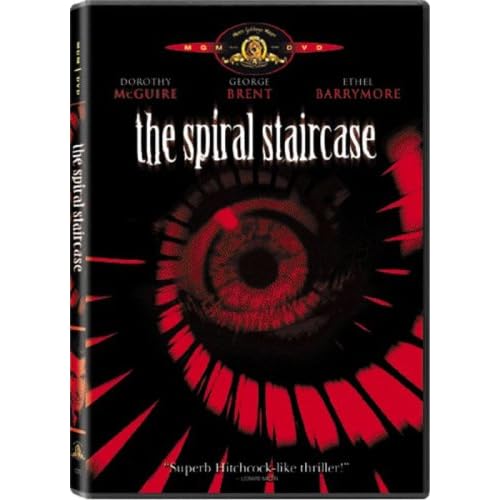
(It's actually the same eye, upside down.)
Last edited by baracine; 01-13-07 at 11:48 AM.
01-13-07 | 01:39 PM
#5
Thread Starter
Suspended
Originally Posted by Zodiac_Speaking
Good transfer, bad cover, no extras, but it a really good movie, but not classic.
Last edited by baracine; 01-13-07 at 01:47 PM.
01-13-07 | 02:27 PM
#6
DVD Talk Legend
i love this movie, and applaude a (thorough) thread about a movie that has been on dvd but out of the public eye for so long.
"The film is a much more enjoyable watch than say, the original Dracula with its static staging. "
this i would disagree with though. I understand how people feel about dracula vs other horror films (and the spanish version) of the same time frame, but In my mind you can't beat Lugosi as Dracula, every bad vampire accent is derived from his performance, and at the time of release it scared people to death.
"The film is a much more enjoyable watch than say, the original Dracula with its static staging. "
this i would disagree with though. I understand how people feel about dracula vs other horror films (and the spanish version) of the same time frame, but In my mind you can't beat Lugosi as Dracula, every bad vampire accent is derived from his performance, and at the time of release it scared people to death.
Last edited by Cameron; 01-13-07 at 02:29 PM.
01-13-07 | 03:00 PM
#7
Thread Starter
Suspended
Originally Posted by Cameron
i love this movie, and applaude a (thorough) thread about a movie that has been on dvd but out of the public eye for so long.
"The film is a much more enjoyable watch than say, the original Dracula with its static staging. "
this i would disagree with though. I understand how people feel about dracula vs other horror films (and the spanish version) of the same time frame, but In my mind you can't beat Lugosi as Dracula, every bad vampire accent is derived from his performance, and at the time of release it scared people to death.
"The film is a much more enjoyable watch than say, the original Dracula with its static staging. "
this i would disagree with though. I understand how people feel about dracula vs other horror films (and the spanish version) of the same time frame, but In my mind you can't beat Lugosi as Dracula, every bad vampire accent is derived from his performance, and at the time of release it scared people to death.
But it's a very different feeling to watch a relatively unknown film like The Ghoul that has an actual forward momentum, and enjoy the eloquence and ease of its actors, the flow and humour of its theatrics, its plot reminiscent of an Agatha Christie whodunit, its perfect atmospheric yet lively photography, its realistic yet stylish action scenes and, of course, its music score. It is also a revelation to see a film of that genre and that era actually filmed in England with English actors freezing their Londonderry airs off in the great British countryside, for a change.
Last edited by baracine; 01-13-07 at 03:32 PM.
01-14-07 | 12:00 AM
#8
DVD Talk Legend
Originally Posted by baracine
But it's a very different feeling to watch a relatively unknown film like The Ghoul that has an actual forward momentum, and enjoy the eloquence and ease of its actors, the flow and humour of its theatrics, its plot reminiscent of an Agatha Christie whodunit, its perfect atmospheric yet lively photography, its realistic yet stylish action scenes and, of course, its music score. It is also a revelation to see a film of that genre and that era actually filmed in England with English actors freezing their Londonderry airs off in the great British countryside, for a change.
All in all though baracine, I really do think this is a great thread. Very well laid out, with explanations, photos, and opinions. Much higher point than just posting, "anyone seen the Ghoul? It pwn3s! LOL!#(Y%)(#_..."
I also don't want to take this into a Universal Monsters vs., or Dracula vs Spansih Dracula (as thats a conversation for another day.)
01-14-07 | 10:05 AM
#9
Thread Starter
Suspended
Originally Posted by Cameron
All in all though baracine, I really do think this is a great thread. Very well laid out, with explanations, photos, and opinions. Much higher point than just posting, "anyone seen the Ghoul? It pwn3s! LOL!#(Y%)(#_..."

And I wouldn't even care for The Ghoul if I didn't have an appreciation for Dracula (both versions).
Last edited by baracine; 01-14-07 at 11:10 AM.
 01-14-07 | 10:48 AM
#12
Thread Starter
Suspended
Originally Posted by Cameron
I agree, It just seems like everyone tries to knock the original Dracula down a notch as the years go by.
When comparing this to any of the Universal monsters films, why not compare to Frankenstein, or the Mummy which is a greater comparison since they share Karloff.

The Old Dark House is a noble effort, with fine direction and a literate script for the genre (based on the novel "Benighted" by J. B. Priestley, about the post WW I "lost" generation), but still lacking in the music department and not nearly as well preserved as The Ghoul, unfortunately. The sound is especially atrocious. (This is a public domain film for which Universal has let its copyright pass, by the way.)
But both Dracula and The Ghoul were based on stage plays. And, as comparisons go, I think The Ghoul would have a been a livelier night at the theatre than Dracula, especially with the Grade A cast of the British film.
Last edited by baracine; 01-15-07 at 09:46 AM.
 01-14-07 | 03:15 PM
#14
DVD Talk Special Edition
Originally Posted by Zodiac_Speaking
Good transfer, bad cover, no extras, but it a really good movie, but not classic.
01-15-07 | 10:28 AM
#15
Thread Starter
Suspended
Totally useless bit of trivia:
Two actors in the film ended up playing the same part in 50's Hollywood historical widescreen blockbusters:
George Relph (uncredited) who plays the doctor in the opening scenes, played
Emperor Tiberius in Ben-Hur (1958), seen here greeting a few guests.

And Ernest Thesiger, who plays Laing the butler, played the same Emperor
Tiberius in The Robe (1953).
Of course, Sir Cedric Hardwicke ended up as a mummy of sorts, playing
Pharaoh Sethi in The Ten Commandments (1956), as well as his
contemporary King Priam in Helen of Troy (1954).

And Sir Ralph Richardson was Themistocles of Athens (right, with Richard Egan) in 300 Spartans (1962).
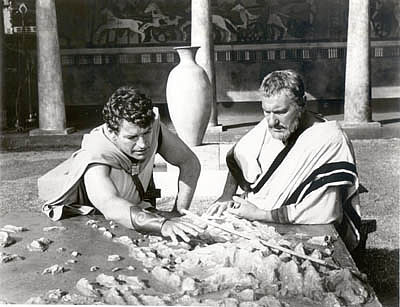
Even D. A. Clarke-Smith (Mahmoud) ended up as Phaon, architect of the new Rome in Quo Vadis (1951). First on the left:

Two actors in the film ended up playing the same part in 50's Hollywood historical widescreen blockbusters:
George Relph (uncredited) who plays the doctor in the opening scenes, played
Emperor Tiberius in Ben-Hur (1958), seen here greeting a few guests.
And Ernest Thesiger, who plays Laing the butler, played the same Emperor
Tiberius in The Robe (1953).
Of course, Sir Cedric Hardwicke ended up as a mummy of sorts, playing
Pharaoh Sethi in The Ten Commandments (1956), as well as his
contemporary King Priam in Helen of Troy (1954).
And Sir Ralph Richardson was Themistocles of Athens (right, with Richard Egan) in 300 Spartans (1962).
Even D. A. Clarke-Smith (Mahmoud) ended up as Phaon, architect of the new Rome in Quo Vadis (1951). First on the left:
Last edited by baracine; 01-15-07 at 01:38 PM.
01-15-07 | 02:47 PM
#16
Member
Joined: May 2005
Posts: 153
Likes: 0
Received 0 Likes
on
0 Posts
Great thread, Baracine.
I have loved The Ghoul for many years, ever since seeing a horribly battered copy on local television in the early hours of the morning. It has great atmosphere, wonderful lighting and one of the best musical scores of the early sound period (only Steiner's King Kong is its equal from that time.) Even the use of a key piece of Wagner for the funeral scene works well and the solid sound restoration of the MGM DVD should not be ignored.
Karloff makes the most of his few key scenes and I really believed that I was looking at a dying man as he gasped his final threat to Thesiger and demanded, "Bandage my hand!"
Most of the time in horror or crime films of this period the humour is forced or ill-considered, but The Ghoul manages to use comedy in a way that that does not dilute the atmosphere. This is mainly through Kathleen Harrison's over-romantic character, but I give a special mention to the landlady at the start who opens the door to see an Arabic gentleman and instantly snorts, "We don't want no lino nor nothin!"
All of the performances are grand. Karloff, I have already mentioned. Cedric Hardwicke is a vile gnome of a lawyer, who upon being told by a Doctor that Karloff's character is approaching death and was not like other men responds, "He'll be like a great many other men soon." Classic stuff.
Ralph Richardson is a sly parson with a kind of amused detachment, Ernest Thesiger as a haunted, religious crook of a man with a Scotish brogue that could cut a steak, even the smaller parts are well played.
Is there any scene in early horror cinema that so takes one aback as Karloff cutting an Egyptian symbol into his flesh of his chest and then proffering his scarred body to the statue of Anubis?
The DVD restoration of this title was a genuine revelation given how poor the earlier VHS and other releases were. It is certainly in my Top Ten Films of all time and almost a contender for Top Five status. A wonderous acheivement for its time.
To add to your wonderful trivia Baracine, The Ghoul must have one of the longest lived casts of all time. Of the eleven credited actors, here are their ages at time of death:-
Boris Karloff - 81
Cedric Hardwicke - 71
Ernest Thesiger - 81 (a day short of his 82nd birthday.)
Dorothy Hyson - 81
Anthony Bushell - 92
Kathleen Harrison - 103 (!)
Harold Huth - 75
D.A. Clarke-Smith - 70
Ralph Richardson - 80
Jack Raine - 82
George Relph - 72
How unusual to see a group of eleven people where all of them reached the age of 70 and none suffered a premature death, seven made it past the age of 80, with one nonogenerian and one centarian. Being involved in The Ghoul seems to have been good for your health!
A great film and an underrated one. Long may this thread live.
I have loved The Ghoul for many years, ever since seeing a horribly battered copy on local television in the early hours of the morning. It has great atmosphere, wonderful lighting and one of the best musical scores of the early sound period (only Steiner's King Kong is its equal from that time.) Even the use of a key piece of Wagner for the funeral scene works well and the solid sound restoration of the MGM DVD should not be ignored.
Karloff makes the most of his few key scenes and I really believed that I was looking at a dying man as he gasped his final threat to Thesiger and demanded, "Bandage my hand!"
Most of the time in horror or crime films of this period the humour is forced or ill-considered, but The Ghoul manages to use comedy in a way that that does not dilute the atmosphere. This is mainly through Kathleen Harrison's over-romantic character, but I give a special mention to the landlady at the start who opens the door to see an Arabic gentleman and instantly snorts, "We don't want no lino nor nothin!"
All of the performances are grand. Karloff, I have already mentioned. Cedric Hardwicke is a vile gnome of a lawyer, who upon being told by a Doctor that Karloff's character is approaching death and was not like other men responds, "He'll be like a great many other men soon." Classic stuff.
Ralph Richardson is a sly parson with a kind of amused detachment, Ernest Thesiger as a haunted, religious crook of a man with a Scotish brogue that could cut a steak, even the smaller parts are well played.
Is there any scene in early horror cinema that so takes one aback as Karloff cutting an Egyptian symbol into his flesh of his chest and then proffering his scarred body to the statue of Anubis?
The DVD restoration of this title was a genuine revelation given how poor the earlier VHS and other releases were. It is certainly in my Top Ten Films of all time and almost a contender for Top Five status. A wonderous acheivement for its time.
To add to your wonderful trivia Baracine, The Ghoul must have one of the longest lived casts of all time. Of the eleven credited actors, here are their ages at time of death:-
Boris Karloff - 81
Cedric Hardwicke - 71
Ernest Thesiger - 81 (a day short of his 82nd birthday.)
Dorothy Hyson - 81
Anthony Bushell - 92
Kathleen Harrison - 103 (!)
Harold Huth - 75
D.A. Clarke-Smith - 70
Ralph Richardson - 80
Jack Raine - 82
George Relph - 72
How unusual to see a group of eleven people where all of them reached the age of 70 and none suffered a premature death, seven made it past the age of 80, with one nonogenerian and one centarian. Being involved in The Ghoul seems to have been good for your health!
A great film and an underrated one. Long may this thread live.
01-15-07 | 04:17 PM
#17
Thread Starter
Suspended
Originally Posted by Hu Phan
Great thread, Baracine.
I have loved The Ghoul for many years, ever since seeing a horribly battered copy on local television in the early hours of the morning. It has great atmosphere, wonderful lighting and one of the best musical scores of the early sound period (only Steiner's King Kong is its equal from that time.) Even the use of a key piece of Wagner for the funeral scene works well and the solid sound restoration of the MGM DVD should not be ignored.
I have loved The Ghoul for many years, ever since seeing a horribly battered copy on local television in the early hours of the morning. It has great atmosphere, wonderful lighting and one of the best musical scores of the early sound period (only Steiner's King Kong is its equal from that time.) Even the use of a key piece of Wagner for the funeral scene works well and the solid sound restoration of the MGM DVD should not be ignored.
Karloff makes the most of his few key scenes and I really believed that I was looking at a dying man as he gasped his final threat to Thesiger and demanded, "Bandage my hand!"
Most of the time in horror or crime films of this period the humour is forced or ill-considered, but The Ghoul manages to use comedy in a way that that does not dilute the atmosphere. This is mainly through Kathleen Harrison's over-romantic character, but I give a special mention to the landlady at the start who opens the door to see an Arabic gentleman and instantly snorts, "We don't want no lino nor nothin!"
All of the performances are grand. Karloff, I have already mentioned. Cedric Hardwicke is a vile gnome of a lawyer, who upon being told by a Doctor that Karloff's character is approaching death and was not like other men responds, "He'll be like a great many other men soon." Classic stuff.

Ralph Richardson is a sly parson with a kind of amused detachment, Ernest Thesiger as a haunted, religious crook of a man with a Scotish brogue that could cut a steak, even the smaller parts are well played.
Is there any scene in early horror cinema that so takes one aback as Karloff cutting an Egyptian symbol into his flesh of his chest and then proffering his scarred body to the statue of Anubis?
The DVD restoration of this title was a genuine revelation given how poor the earlier VHS and other releases were. It is certainly in my Top Ten Films of all time and almost a contender for Top Five status. A wonderous achievement for its time.
To add to your wonderful trivia Baracine, The Ghoul must have one of the longest lived casts of all time.
Spoiler:

Last edited by baracine; 09-27-07 at 01:29 PM.
01-21-07 | 09:52 AM
#18
Thread Starter
Suspended
I've taken this screen cap of a fog scene from the film:

(Click on thumbnail for full size.)
Here's another image showing incredible gradation:
 NEW screen cap, showing more luminosity (the white of the eye on the left is visible as it is on screen):

More on demand...

(Click on thumbnail for full size.)
Here's another image showing incredible gradation:
NEW screen cap, showing more luminosity (the white of the eye on the left is visible as it is on screen):
More on demand...
Last edited by baracine; 01-23-07 at 08:49 AM.
01-21-07 | 10:45 AM
#19
Thread Starter
Suspended
Oh, what the hell... One more:

(Aba Ben Dragore/Howard Huth is preparing a refreshing drink of absinthe, in more detail than has ever been shown on screen before or since...)
These were done by using the "Print Screen" button during playback in InterActual DVD player and copying to Paint. The images were corrected for luminosity by Microsoft Office Picture Manager and posted on ImageShack free image hosting.

(Aba Ben Dragore/Howard Huth is preparing a refreshing drink of absinthe, in more detail than has ever been shown on screen before or since...)
These were done by using the "Print Screen" button during playback in InterActual DVD player and copying to Paint. The images were corrected for luminosity by Microsoft Office Picture Manager and posted on ImageShack free image hosting.
Last edited by baracine; 01-21-07 at 11:03 AM.
 01-21-07 | 03:34 PM
#22
Thread Starter
Suspended
Another masterpiece of lighting and art direction:

Cedric Hardwicke to Anthony Bushell: "That's a very old carpet you're standing on and I would be grateful if you didn't kick it to pieces."
Other sizes:
Cedric Hardwicke to Anthony Bushell: "That's a very old carpet you're standing on and I would be grateful if you didn't kick it to pieces."
Other sizes:

Last edited by baracine; 01-21-07 at 03:47 PM.
01-21-07 | 11:30 PM
#23
Member
Joined: May 2005
Posts: 153
Likes: 0
Received 0 Likes
on
0 Posts
Hardwicke's office is extraordinary. It makes you wonder how he ever got any business as a lawyer. Perhaps that is why he turned a little greedy?
I might try and get some frame captures from one of the older VHS releases just for comparative purposes.
I might try and get some frame captures from one of the older VHS releases just for comparative purposes.
01-22-07 | 07:42 AM
#24
Thread Starter
Suspended
Originally Posted by Hu Phan
Hardwicke's office is extraordinary. It makes you wonder how he ever got any business as a lawyer. Perhaps that is why he turned a little greedy?
I might try and get some frame captures from one of the older VHS releases just for comparative purposes.
I might try and get some frame captures from one of the older VHS releases just for comparative purposes.
Last edited by baracine; 01-22-07 at 10:29 AM.
